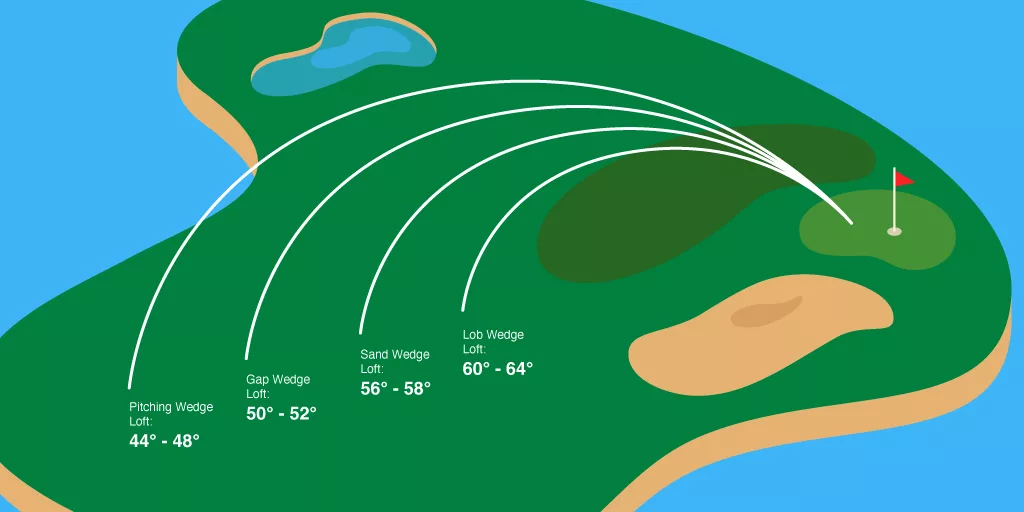
Wedge lofts range from 44-48 degrees (pitching wedge) up to 58-62 degrees (lob wedge), with each wedge covering roughly 10-15 yards. More loft means shorter carry and steeper descent. Simple enough. But your actual distances depend on swing speed, strike quality, ball type, and turf conditions, so treat the chart below as a starting point for a mid-handicapper with moderate swing speed, not gospel.
- Pitching wedge loft: 44-48 degrees in traditional sets, 41-45 degrees in most current iron sets.
- Gap wedge loft: 50-52 degrees. In a current iron set, the matching gap or approach wedge is usually 46-50 degrees.
- Sand wedge loft: 54-56 degrees, with 56 the most common.
- Lob wedge loft: 58-62 degrees, with 60 the most common.
| Wedge Type | Loft (Degrees) | Distance (Yards) | Bounce | Common Use |
|---|---|---|---|---|
| Pitching Wedge | 44-48 degrees | 100-130 yards | 2-5 degrees | Full approach shots |
| Gap Wedge | 50-52 degrees | 80-110 yards | 5-10 degrees | Filling the gap between PW and SW |
| Sand Wedge | 54-56 degrees | 70-90 yards | 10-14 degrees | Bunker shots and pitch shots |
| Lob Wedge | 58-62 degrees | 40-70 yards | 4-10 degrees | High soft shots around the green |
How Wedge Loft Affects Distance
More loft means a higher launch angle, which sends energy upward instead of forward. The ball climbs steeply but doesn't carry as far. That's why a 46-degree pitching wedge flies 30-40 yards farther than a 60-degree lob wedge on the same swing. No mystery there.
Loft is only part of the equation, though. Swing speed is the biggest variable. A player who swings 90 mph will hit a sand wedge 85 yards, while someone at 75 mph might top out at 70. Ball type plays a role too: premium urethane covers spin more and can fly slightly shorter than firm two-piece balls. And turf conditions matter more than most people realize. A tight fairway lie launches clean and hot, while thick rough kills distance fast. The chart above assumes a mid-handicapper swinging at moderate speed from a decent lie.
Pitching Wedge and Approach Wedge Lofts by Brand
Iron-set pitching wedges have gotten stronger over the last 30 years. A pitching wedge in the 1990s was about 47-48 degrees. In today's game-improvement sets it is often 41-43 degrees, which is closer to an old 9 iron. That is why most sets now include a matching approach wedge (labeled AW, GW, UW, or W) at 46-50 degrees. Here are the stock lofts for popular current sets, taken from manufacturer spec sheets.
| Iron Set | Pitching Wedge | Next Set Wedge |
|---|---|---|
| Callaway Elyte | 42 degrees | AW 47 degrees |
| Callaway Apex Ai200 | 43 degrees | AW 48 degrees |
| TaylorMade Qi Max | 42.5 degrees | AW 48 degrees |
| TaylorMade P790 | 44 degrees | AW 49 degrees |
| Titleist T100 | 45 degrees | W 49 degrees |
| Titleist T150 | 44 degrees | W 48 degrees |
| Titleist T250 | 43 degrees | W 48 degrees |
| Titleist T350 | 43 degrees | W 48 degrees |
| Ping G440 | 42 degrees | UW 47 degrees |
| Ping i240 | 45 degrees | UW 50 degrees |
| Mizuno JPX925 Hot Metal | 42 degrees | GW 48 degrees |
| Mizuno Pro 243 | 44 degrees | GW 48 degrees |
| Cobra DS-Adapt | 42 degrees | GW 48 degrees |
| Srixon ZXi5 | 44 degrees | AW 50 degrees |
If your set has a 42-43 degree pitching wedge and you go straight to a 56 degree sand wedge, you have a 13-14 degree hole in your bag. Adding the set's approach wedge or a standalone 48-50 degree wedge closes it. See our iron loft chart for the rest of the set.
What Degree Is an Approach Wedge?
An approach wedge is usually 48-52 degrees. "Approach wedge" (AW) is another name for a gap wedge. Callaway, TaylorMade, and Srixon label it AW, Ping calls it a utility wedge (UW), Mizuno and Cobra use GW, and Titleist uses W. The matching approach wedge in a current iron set is usually 46-50 degrees, while standalone gap wedges like a Vokey or Cleveland are usually sold at 50 or 52 degrees. A full swing with an approach wedge carries roughly 80-110 yards for a mid-handicapper.
What Bounce Angle Means for Wedge Selection
Bounce is the angle between the leading edge and the lowest point of the sole. Think of it as a built-in safeguard: more bounce keeps the club from digging, less bounce lets the leading edge slide under the ball on tight lies. Get it wrong, and you'll chunk soft lies or blade firm ones.
High bounce (10-14 degrees) is your friend in soft conditions, fluffy rough, and powdery bunker sand. It skids through the turf instead of knifing into it. Low bounce (4-6 degrees) is better on firm courses with tight fairways and hard-packed sand. If you try high bounce off a concrete-like lie, the sole bounces up and you catch the ball thin. Medium bounce (7-10 degrees) splits the difference and honestly works for most amateurs who play different courses week to week. If you only buy one sand wedge, go medium bounce.
How Many Wedges Should You Carry?
Three to four. The goal is even distance gaps of 10-15 yards from about 130 yards in. Too few wedges means awkward half-swings to cover in-between distances. Too many eats into the rest of your bag.
The bare minimum is a pitching wedge plus a sand wedge. That works, but it leaves a 20-30 yard gap that makes approach shots from 90-100 yards a guessing game. Adding a gap wedge (50-52 degrees) fills that hole and is the single best upgrade most mid-handicappers can make. A fourth wedge, the lob wedge (58-60 degrees), is worth it if you play firm greens with tight pins, but be honest with yourself. It's the hardest club in the bag to hit consistently, and plenty of good players get by opening a sand wedge instead.
Start by checking your pitching wedge loft, then space your wedges in 4-6 degree increments from there. A 46-degree PW pairs well with a 50, 54, and 58. A 44-degree PW might warrant a 48, 52, 56, and 60 if you have room in the bag. Map the yardage gaps on the range before you commit.
52 vs 56 vs 58 Degree Wedges: Which Lofts to Pair
Every 4 degrees of loft is worth roughly 10-15 yards of full-swing carry. So a 52 and a 58 sit about 6 degrees apart, which works out to a 15-25 yard gap. A 54 and a 58 are only 4 degrees apart and overlap more, so most players pick one or the other.
- 52 degree wedge: a gap wedge. It is a full-swing approach club for roughly 80-110 yards and also works for longer chips that need some roll.
- 54 or 56 degree wedge: the traditional sand wedge. It is the best all-around bunker club and covers full shots of roughly 70-95 yards.
- 58 degree wedge: a lob wedge with a bit less loft than a 60. It hits higher, softer shots around the green and still works from greenside bunkers, which is why many players carry a 58 as their only high-lofted wedge.
If you carry only two wedges after your pitching wedge, 52 and 58 is the most common pairing. If you have room for three, 50, 54, and 58 or 52, 56, and 60 keep the gaps even. Use your pitching wedge loft to decide, as shown below.
| Your PW Loft | Wedges to Add | Gap Between Each |
|---|---|---|
| 43-44 degrees | 48, 52, 56, 60 | 4 degrees |
| 45-46 degrees | 50, 54, 58 | 4 degrees |
| 47-48 degrees | 52, 56, 60 | 4 degrees |
| Any (short setup) | 52, 58 | 6 degrees |