The average male recreational golfer drives the ball approximately 215 yards. The average female golfer drives approximately 148 yards. PGA Tour players average 295-300 yards off the tee.
If you have ever wondered how your driving distance compares to other golfers, you are not alone. Distance off the tee is one of the most-discussed topics in the game. Understanding where you stand relative to your peers - and what factors drive the gap - can help you set realistic goals and identify the right areas to work on. Below you will find data from the USGA's 2021 Distance Report along with context on what the numbers mean for your game.
Average Driving Distance by Age and Gender
The USGA's 2021 Distance Report tracked real amateur golfer data across handicap ranges for both men and women. Here is what the numbers show.
Average drive for a male golfer across all handicaps
| Handicap | <6 | 6-12 | 13-20 | 21+ | Overall |
| Average Distance (Yards) | 239.2 ± 2.7 | 219.8 ± 1.8 | 200.0 ± 2.5 | 176.6 ± 6.8 | 215.6 ± 1.4 |
| Longest Drive (Yards) | 335.3 | 317.0 | 321.3 | 266.5 | 335.3 |
| Driver Usage (%) | 84.5% | 88.6% | 89.3% | 96.7% | 88.2% |
| No. Shots | 207 | 499 | 375 | 60 | 1141 |
The overall male average of around 216 yards might sound achievable, but notice that even mid-handicappers (6-12) average just under 220. For higher-handicap golfers, a consistent 200 yards is a solid target to build toward. Consistency matters far more than hitting the occasional long drive.
Average drive for a female golfer across all handicaps
| Handicap | <6 | 6-12 | 13-20 | 21-28 | 29+ | Overall |
| Average Distance (Yards) | 196.7 ± 2.6 | 177.5 ± 1.3 | 155.0 ± 1.1 | 141.5 ± 1.0 | 119.8 ± 1.9 | 147.9 ± 0.7 |
| Longest Drive (Yards) | 261.5 | 254.2 | 255.6 | 227.1 | 207.1 | 261.5 |
| Driver Usage (%) | 97.4% | 96.1% | 97.1% | 98.0% | 94.8% | 96.9% |
| No. Shots | 76 | 356 | 819 | 937 | 325 | 2513 |
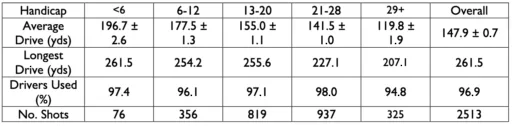
The female average sits at roughly 148 yards across all handicaps. Unless you are a low-handicap player, targeting 150 yards with reliable consistency is a better benchmark than chasing distance. Women who are newer to the game often benefit more from improving contact quality than from swinging harder.
Driving distance also decreases with age. Golfers in their 20s and 30s generally hit the ball farthest, while those in their 50s and 60s typically see a drop of 10-20 yards or more compared to their peak. The best drivers for seniors are specifically designed to help recover some of that lost distance through higher launch and lower spin.
PGA Tour Driving Distance
Compared to recreational golfers, PGA Tour professionals operate at a completely different level. Advances in equipment, strength training, and swing technique have pushed tour averages steadily upward over the decades.
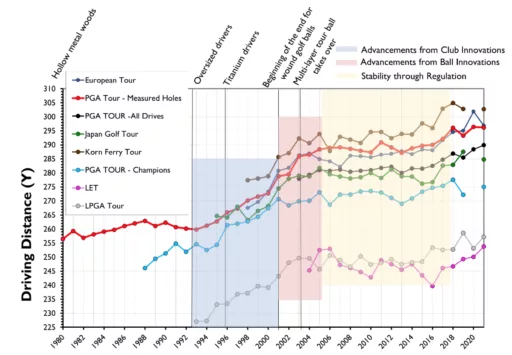
Even in the 1980s, the tour average was around 255 yards. By 2020, that number had climbed to approximately 295 yards, and the longest hitters on tour now regularly exceed 320-330 yards. The longest drive in golf history currently stands at 515 yards, set under exceptional conditions. For perspective on what elite ball striking looks like, tour pros swing the club at 110-120 mph compared to the recreational average of around 93 mph for men.
What Affects Driving Distance?
Four main variables determine how far your ball travels off the tee.
Swing speed is the biggest factor. Club head speed at impact directly determines how much energy transfers to the ball. The USGA data shows that lower-handicap golfers swing faster, which is a large part of why they hit it farther. Improving your swing mechanics and physical fitness are the two most effective ways to increase speed.
Ball speed and smash factor measure how efficiently you transfer club speed to ball speed. Even with the same swing speed, hitting the ball on the center of the face produces significantly more distance than an off-center hit. A smash factor of 1.5 is the benchmark for efficient contact with a driver.
Launch angle and spin rate work together to shape your trajectory. Most recreational golfers launch the ball too low with too much spin, which limits carry. The optimal launch angle for a driver is roughly 12-15 degrees with a spin rate under 2,800 rpm. A proper fitting can dial in these numbers quickly.
Equipment plays a real role, especially for golfers with slower swing speeds. A driver that is properly fit for your swing - correct loft, shaft flex, and shaft weight - can add 10-20 yards without changing anything about how you swing. Check out our picks for the best golf drivers and, if you are newer to the game, the best drivers for beginners.
How to Increase Your Driving Distance
The most direct path to more distance is improving your swing speed through better mechanics and physical conditioning. Working with a qualified instructor to optimize your swing sequence, tempo, and body rotation will produce more consistent speed gains than any equipment change. Even a 5 mph increase in club head speed translates to roughly 10-15 yards of added distance.
Improve your ball striking consistency. Hitting the center of the face - not just swinging harder - is the fastest way most recreational golfers can pick up real distance. Foot-spray or impact tape on the face during practice sessions reveals exactly where you are making contact, and drills that promote centered contact are among the highest-value things you can work on.
Get a driver fitting. A custom fitting that matches loft, shaft flex, and shaft weight to your swing can unlock distance you are currently leaving on the table. Many golfers are playing with equipment that does not suit their swing speed or attack angle. A properly fit driver is especially valuable for seniors and beginners.
Work on your physical fitness. Increasing rotational strength and flexibility directly translates to more club head speed. Exercises targeting your hip rotation, core stability, and thoracic mobility are the most golf-specific areas to focus on. Even modest gains in these areas can produce noticeable improvements on the course.
Understanding how far the average golfer drives the ball gives you a useful reference point, but the goal is always to improve relative to your own baseline. Whether you are looking for the right equipment or working on your technique, small consistent gains add up. For equipment recommendations, see our guide to the best golf drivers available right now.
Frequently Asked Questions
According to the USGA's 2021 Distance Report, the average male recreational golfer drives the ball 215.6 yards. The average female golfer drives approximately 147.9 yards. These numbers span all handicap levels, so mid-handicap men typically average closer to 200-220 yards depending on their skill level.
A good driving distance for a recreational male golfer is 220-240 yards, which puts you in the low-to-mid handicap range. For women, 170-200 yards is a strong benchmark. More important than raw distance is consistency - hitting the fairway at 200 yards is more valuable than occasionally reaching 240 yards while missing the short grass.
Senior male golfers (60+) typically average 175-195 yards with the driver. Senior women often average 130-150 yards. Distance naturally decreases with age as swing speed slows, but the right equipment can help. Drivers designed for seniors with higher loft, lighter shafts, and larger sweet spots can recover meaningful distance. See our recommendations for the best drivers for seniors.
Yes. Driver loft significantly affects both launch angle and spin rate, which together determine how far the ball carries. Golfers with slower swing speeds (below 90 mph) generally benefit from more loft - 12-15 degrees or higher - to optimize their launch conditions. Faster swingers can typically use less loft. Most recreational golfers are better off with more loft than they think.
Most golfers lose roughly 1-2 yards of driving distance per year after age 40, with losses accelerating after age 60. The primary cause is a reduction in swing speed as flexibility and muscle mass decline. Over a decade, that can amount to 15-25 yards. Strength and flexibility training, combined with properly fit equipment, can slow or partially offset these losses.